Overview
The Pampa Medina project is an exploration and development project acquired by Marimaca Copper in October 2024.
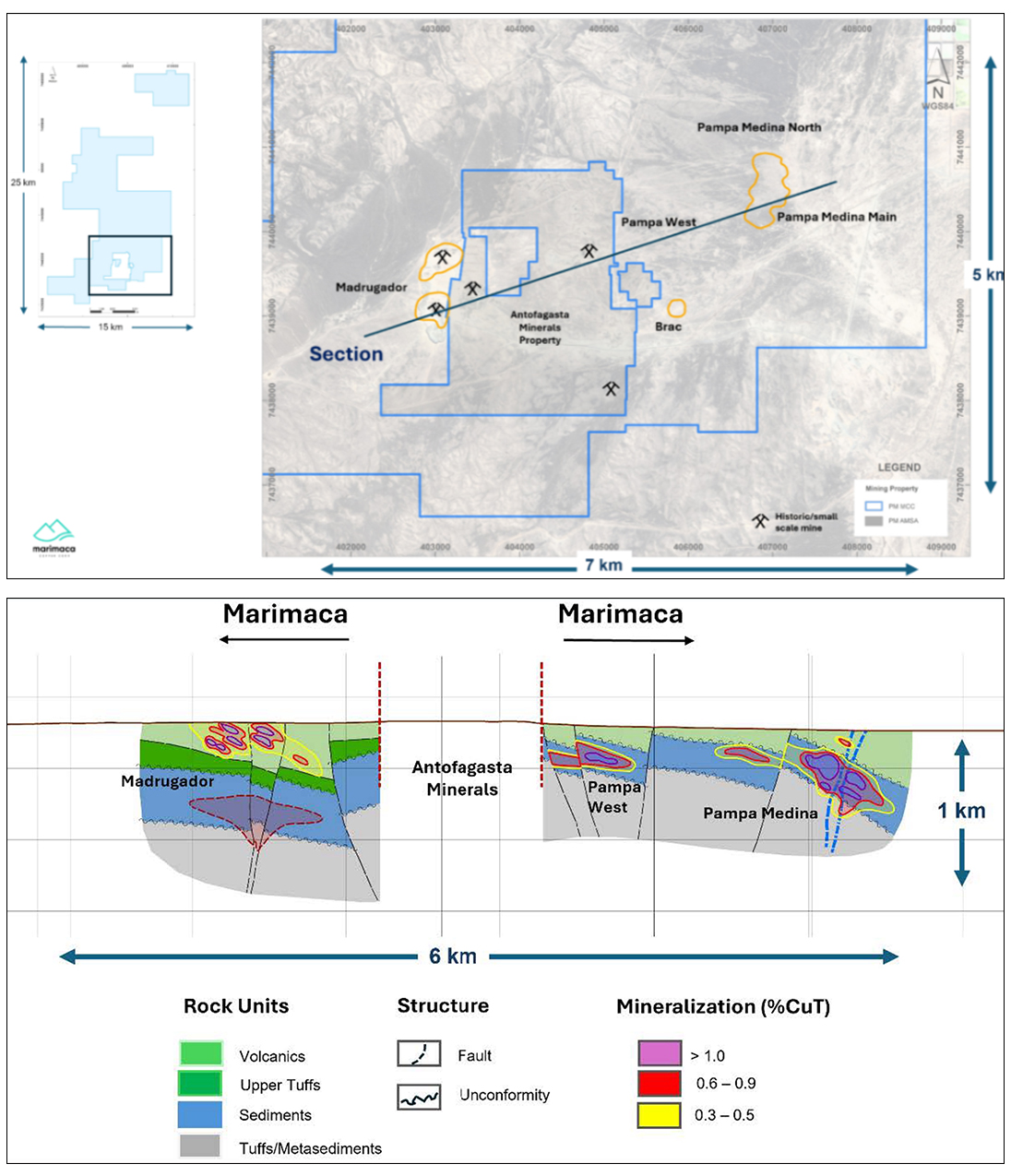
Pampa Medina lies approximately 28 km from Marimaca’s flagship Marimaca Oxide Deposit (MOD) project and is located within the southern portion of the Company’s broader 14,500ha Sierra de Medina property package with no private land ownership. The claims also include the Madrugador claims which hosts a copper oxide deposit with a historical National Instrument 43-101 non-compliant resource estimate.
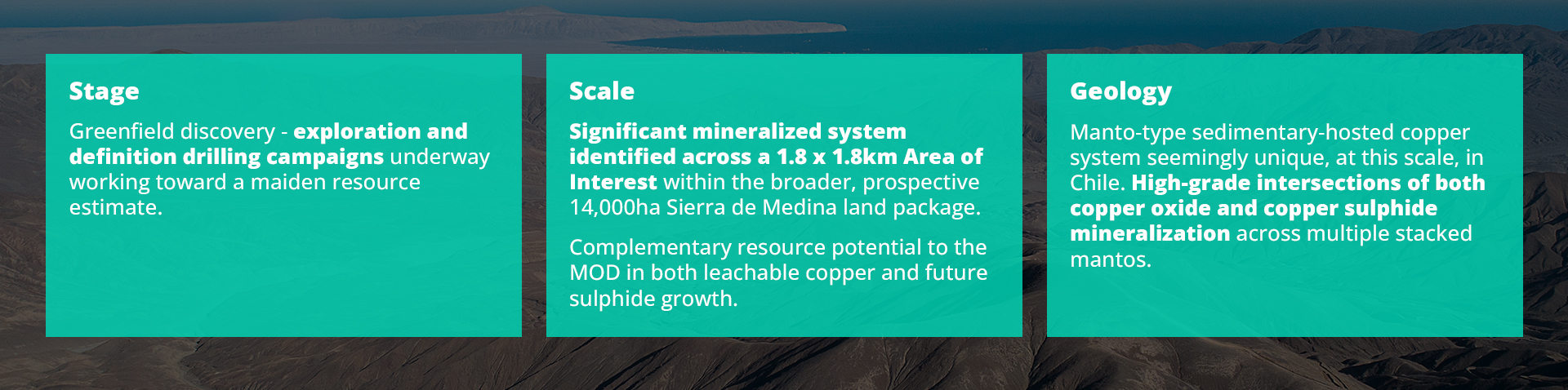
In November 2025 Marimaca completed the 10,000m discovery drill program focusing on broad step out holes from the existing known mineralisation, which has provided exceptional results to date. Notably, early drilling has revealed a high-grade, sedimentary hosted copper sulphide system at depth, emerging as a major new driver of potential value within the broader Marimaca district. These results demonstrate compelling district scale exploration with both copper oxide and sulphide potential. A follow-up 30,000m Phase II drilling program is currently ongoing, which represents the first district wide program designed to map the full-extent of this tier 1 opportunity.
At a Glance
Regional Synergies and Exploration Potential
Pampa Medina is located both close to the planned Marimaca Oxide Deposit as well as other existing regional infrastructure.
Sulphide Discovery and Drilling
Marimaca recently completed the 10,000m drilling program testing the depth and lateral extents of the oxide and sulphide potential at Pampa Medina.
Led by renowned Chilean exploration geologist Sergio Rivera, VP Exploration, early drill results have already been promising. In July 2025, Marimaca reported outstanding drill results from the Pampa Medina project, confirming the first intersection of an exceptionally high-grade copper (>5% CuT with 15m true thickness) sulphide mineralization at depth. The near-surface oxide mineralization horizon continues to be expanded across a 1.6km by 1.4km area, with the deposit remaining open in all directions.
These results marked a major step forward for the project, highlighting both its near-surface oxide potential and a newly emerging zone of very high-grade bornite and chalcopyrite mineralization at depth. This represents the first known discovery in Chile of oxide and sulphide mineralisation of this scale within a single, continuous sedimentary hosted copper system. Highlights to date from the ongoing drilling campaign included:
• Hole SMRD-13 intersected exceptional 6m of 12.0% CuT within 26m of 4.1% CuT in dominantly Bornite
• Hole SMRD-12 intersected 56m @ 1.4% CuT and materially extended the sedimentary horizon 300m to the west
• Hole SMD-02 returned 40 metres at 2.1% CuT, confirming the strong continuity of mineralisation and expanding the system to the east.
• Hole SMRD-20 intersected 38m of 1.48% Cu from 540m (sulphides) within 90m of 0.96% Cu from 488m, both within a broader intersection of 198m of 0.65% Cu (mixed oxides/sulphides), expanding the known system 300m north
• Thick (>15m true thickness), ultra high grade (>5% CuT) zones identified more than 1.4km apart in the same lithological horizon
• Hole SMRD-22 intersected 48m of 2.05% Cu from 186m, within 160m of 0.92% Cu from 102m (oxides)
The most recent 300m step-out holes SMRD-16 and SMRD-20 materially extend the high-grade manto to the west and north, increasing the defined mineralized stratigraphy across a 1.6km by 1.4km area (as shown in figure ‘300m step-out holes confirm sulphide mineralization remains open’). Weakly mineralized sandstones were intercepted from 116m, with the main high-grade mixed-sulphide, sediment hosted mineralization starting at 438m downhole. Hole SMRD-15 was planned to confirm the uplifted basement in the eastern direction of the Pampa Medina main target. Oxide mineralization was intercepted at 122m, extending to 204m depth. Further exploration will focus on the western and northern regions of the Pampa Medina main target, which both remain open. High-grade sediment hosted mineralisation continues to show in these step-out holes, with the extension of the thick, high grade manto mineralization open in all directions with the most promising results coming from the west extensions.
The follow-up Phase II 30,000m drilling program is ongoing with a focus on step outs toward the northern and western regions.
Geological Overview
Pampa Medina sits in a broad, flat pampa valley within Chile’s Atacama Desert. Pampa Medina is a stratiform or manto-style copper deposit dominantly hosted in Jurassic-Triassic sedimentary units (sandstones, conglomerates, tuffs and black shales) overlain by andesitic volcanics and underlain by an Upper Paleozoic complex of metamorphosed sediments, volcanics and intrusions. It’s intruded by a dyke swarm and affected by post mineral normal faulting. Copper was originally identified in near-surface oxide mineralization dominated by atacamite, chrysocolla and both secondary and primary chalcocite, and has now been identified in high-grade zones of chalcopyrite and bornite which extend laterally down-dip beyond the oxide-primary transition.
Following Marimaca’s consolidation of the project area and surrounding land packages in 2024, the Company reinterpreted all available geological information (for the first time as one) and developed an updated geological model for Pampa Medina, which identified the lower sedimentary units of interbedded sandstones, shales and conglomerates as the productive horizons for future drill targeting. Oxide copper mineralization was re-logged utilizing historical drilling in near-surface, uplifted blocks, with the model of continuity in the intact lithological sequence in deeper blocks for primary mineralization to be tested by Marimaca’s 2025 drilling campaign.
Oxide Potential
The Pampa Medina oxide project has been defined by five core zones within the Sierra de Medina claims: Pampa Medina Main, Pampa West, and Madrugador. Relogging and reinterpretation of the historical drilling (41,000m at Pampa Medina and 36,373m at Madrugador) indicates the continuity of the manto system across the 4km x 5km district. The Madrugador deposit hosts oxide mineralization within volcanics exposed at surface provides a low-strip opportunity to complement the high-grade oxide manto at Pampa Medina.